Posts Tagged: booking

What Twenty Years of Building Booking Software Has Taught Us

MIDAS 20 YEAR ANNIVERSARY

We hear a version of the same story more often than you’d think: an organization gets in touch because their current booking system is going away. Sometimes the vendor got acquired and folded into a bigger platform. Sometimes a “free” tool they’d come to depend on quietly shut down. Sometimes a school management system swallowed the booking module they liked and replaced it with one they didn’t.

Whatever the cause, the result is the same – a business manager or facilities coordinator staring down a migration they didn’t ask for, hoping the data export comes out clean.

We’ve been building MIDAS since 2006, and stories like that are a big part of why we still are. So we wanted to write plainly about what we think actually matters when you’re choosing software that a school, a church, or a community group is going to depend on for years, not months – and where we think MIDAS earns its place.

The deployment question nobody else lets you ask

Almost every booking system on the market today makes one decision for you before you’ve even seen a demo: it will live on someone else’s servers, in someone else’s cloud, under someone else’s terms. For a lot of organizations that’s completely fine. For a lot of others – schools with strict data protection obligations, churches wary of where congregation data ends up, government bodies with procurement rules that basically require it – that’s a non-starter.

MIDAS is one of the few systems left that genuinely lets you choose.

Run it on your own server, behind your own firewall, backed up on your own schedule, and your booking data never has to leave the building. Or let us host it, if server maintenance isn’t something you want on your plate. Either way works, and – this is the part people are often surprised by – you can move between the two later if your circumstances change. Most vendors only built one option, so they don’t offer that choice at all.

Why “since 2006” is actually a selling point

Here’s a number that we think says more about MIDAS than any feature list could: the median organization using MIDAS today has been with us for over nine years. Not nine months. Nine years.

We bring this up not to boast but because we think it answers the real question underneath “which software should we buy?” – which is really “will this still be here, and will it still work, in five years?

A lot of the room booking space right now is genuinely unstable: companies get bought, folded into bigger suites, sunset, rebranded, repriced. MIDAS has been continuously developed since 2006, and we’re not trying to get acquired or chasing a quarterly roadmap review that might decide room booking is no longer “core.” It’s the whole business, and it has been for twenty years.

Pricing that doesn’t need a phone call to understand

Plenty of software in this space keeps its pricing behind a “contact sales” button – in fact in our own research we found that almost a third of software vendors don’t publish pricing – and we’ve never liked that as an approach.

So MIDAS doesn’t work that way. Every price is published, openly, on our website, based on exactly two things – how many venues you need and how many users you need. No per-booking charges that punish you for actually using the software. No mystery enterprise tier that only reveals itself after a demo. You can work out your exact cost in about thirty seconds, and when it’s time to renew, the price is the same standard rate you already know (subject to currency fluctuations), not some number that’s crept up while you weren’t looking.

If you’re the person who has to justify a line item to a board, a council, or a budget committee, that kind of transparency tends to matter more than people expect.

We’re not trying to be everything

This one took us a while to say plainly, so let’s just say it: MIDAS is not a church management system. It’s not a school information system. It’s not a facilities maintenance platform. If what you actually need is one giant piece of software that handles giving, attendance, gradebooks, and work orders as well as room bookings, there are products built for exactly that, and we’d rather tell you that upfront than pretend otherwise.

What we have noticed, though, is that booking is usually the thing those all-in-one systems treat as an afterthought – a module maintained alongside features that matter more to the wider platform. The organizations that come to MIDAS from a bundled suite tend to say some version of the same thing: booking finally works the way they need it to, and everything else they were using keeps doing its job right alongside it. MIDAS is built to integrate with the tools you already run, not to replace them.

If any of this sounds familiar

Maybe your team is juggling a shared calendar and a spreadsheet of “who’s using the hall Thursday.” Maybe you’re facing a migration because a system you relied on is being discontinued or absorbed elsewhere. Maybe you just want to know, in plain numbers, what a proper booking system would actually cost your organization.

Either way, there’s no obligation to talk to anyone first. Try MIDAS free for 30 days with your own rooms and your own schedule, or just look up your exact price right now.

Start your free 30-day trial – no credit card required.

See pricing for your organization – published openly, no sales call needed.

How to Visually Book From A Floor Plan or Map

Visually book from a floor plan or layout map

Ever since the first version of our MIDAS room booking software, users choose spaces they wish to book from a “list” of available rooms.

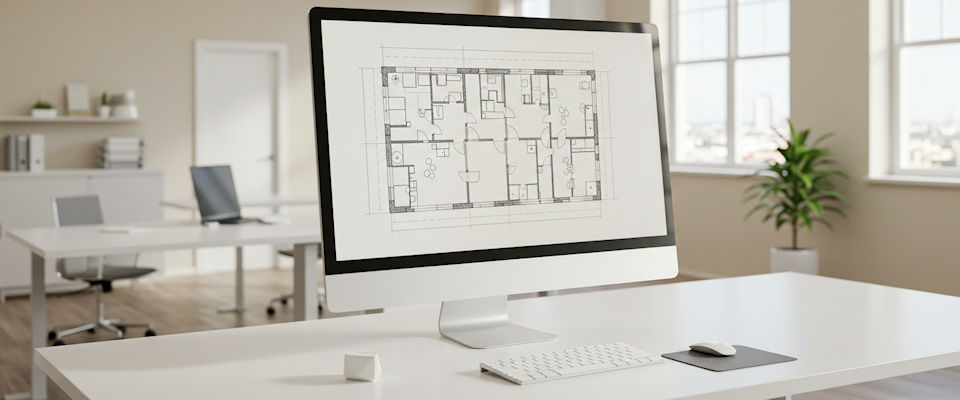
Starting with MIDAS v4.31, we’re excited to now offer an alternative – the ability to book spaces by simply selecting them on a graphical floor plan, map, or schematic of your facilities.

How to set up floor plans and maps in MIDAS

Administrators can choose whether MIDAS shows a “list” of venues to users, or allows the selecting of venues from a visual floor plan or map. This is done though a setting which may be accessed via MIDAS Admin Options → Manage MIDAS → Bookings → Floorplans / Maps.

Assign venues to groups

To be able to use floor plans or maps in MIDAS, you’ll first need to assign your venues (rooms / bookable spaces) to venue groups. Each venue group can have a floor plan or map associated with it.

For example, if your building has two floors, you could have a dedicated floor plan / map for each floor. In order to do this, you’ll need to assign all your first floor rooms to one venue group, and all your second floor rooms to another venue group.

Here’s a quick tutorial on how to assign venues to groups:

Upload a floor plan / map

Once you’ve “grouped” your bookable spaces, you can then upload an image of a floor plan, map, or schematic in which those bookable spaces appear.

You can do this via MIDAS Admin Options → Manage Venues → Groups.

Select the venue group you wish to upload an image for. Next, click the “Map” button to open the Map Editor.

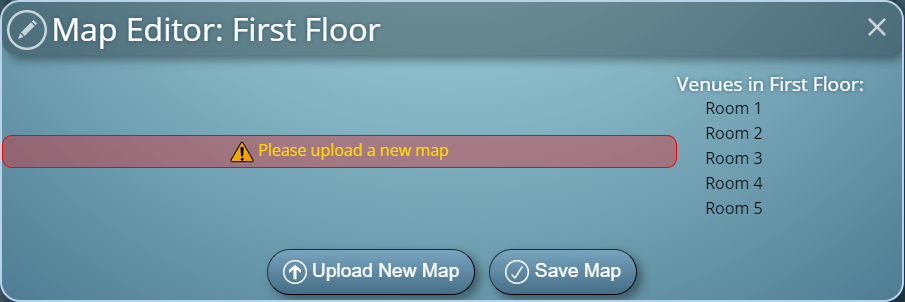
In the Map Editor, click the “Upload New Map” button to select an image from your device to upload.

Upload a new floor plan, map, or schematic in MIDAS

Your upload should be a PNG image file with dimensions of at least 200 x 200 pixels.

Define areas on your floor plan / map

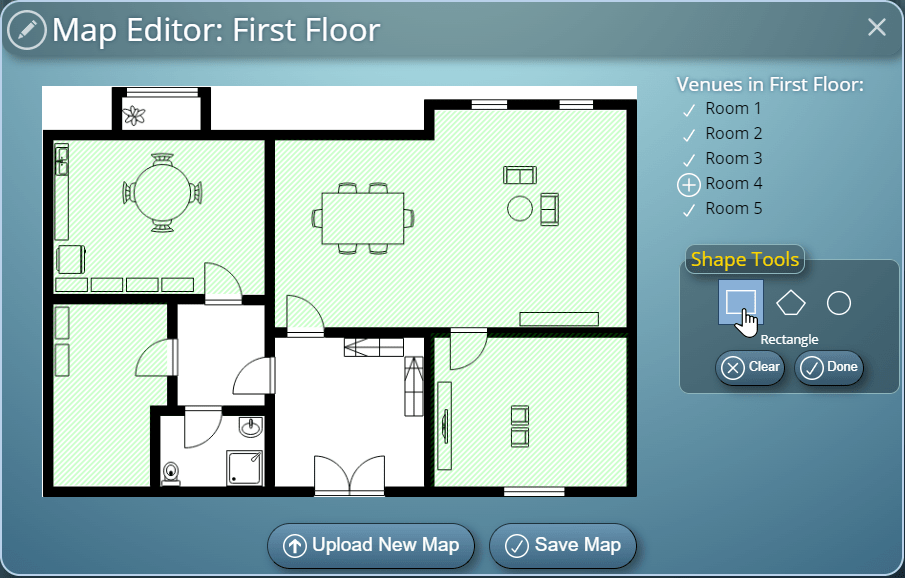
Once you’ve uploaded your map, you’ll then need to tell MIDAS the position of each of your bookable spaces on that image.

To do that, select the “+” icon alongside one of the bookable spaces in the group from the right side of the Map Editor.

The “Shape Tool” selector will then open. This allows you to select whether you wish to define a rectangle, polygon, or circle area on your floor plan / map for the space you’ve selected.

The Floor Plan / Map Editor in MIDAS

Accommodating Rooms of all Shapes and Sizes

For square or rectangular rooms, select “Rectangle“, then:

  • Click on one corner of the room on your floor plan / map (i.e. the upper left corner of the room)
  • Click on the opposite corner of the room on your floor plan / map. (i.e. the lower right corner of the room)

For irregular shaped rooms, select “Polygon“, then:

  • Click on each point in room on your floor plan / map where the perimeter walls change direction.
  • Once you’ve done this around the room’s entire perimeter, click “Done”.

For circular rooms, select “Circle“, then:

  • Click on the center of the room on your floor plan / map.
  • Click on a point on the perimeter of the room on your floor plan / map.

Once you’ve defined an area on your floor plan / map, a “tick” icon will be shown next to the name of the bookable space in the venue list.

If you make a mistake, you can easily clear an area by tapping the tick icon next to the name of the venue. The icon will change to a cross, and tapping this will remove that area from the map. You’ll then be able to recreate a new area.

Once you’ve defined areas on your map for each of your venues, click “Save Map” to save changes.

What end-users see

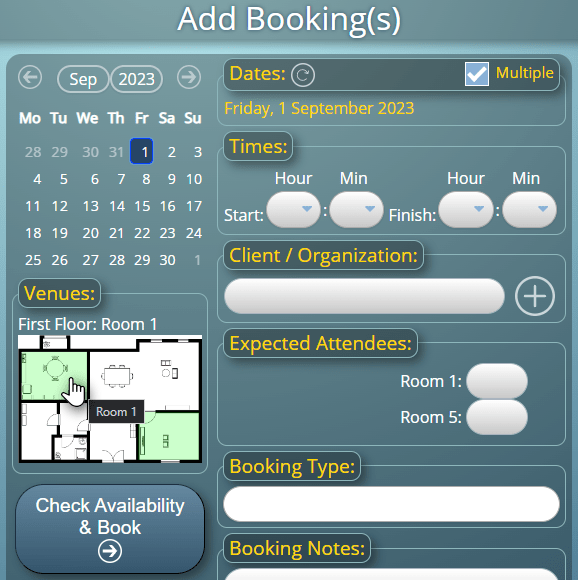
When a user clicks the “Add Bookings” icon in their MIDAS toolbar, they’ll see the floor plans / maps you’ve created for each of the venue groups the user has been granted permission to access. These are shown instead of the usual “list” of venues to choose from.

Visually selecting venues from a floor plan on the Add Bookings screen

Selecting a venue is then as simple as clicking on it on the floor plan. Each selected space will be highlighted in green on the floor plan. Multiple spaces may also be selected concurrently on each floor plan.

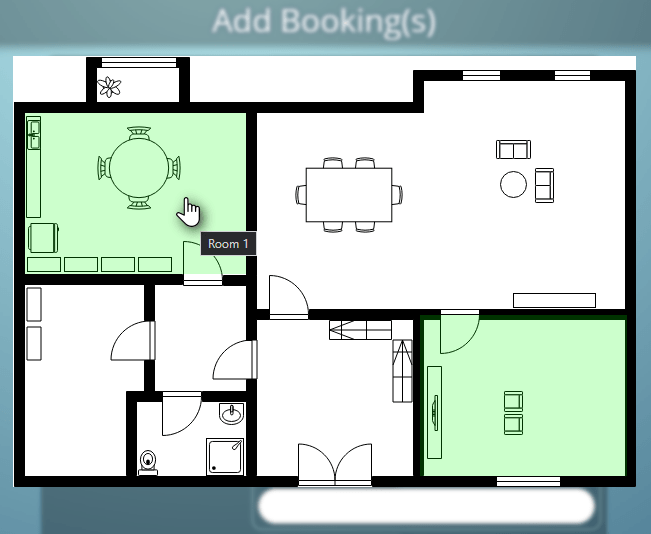
A larger floor plan may also be opened by clicking on the name of the venue group. This bigger floor plan makes it easier to select rooms on larger layouts:

Users can click to zoom a floor plan for a larger version from which venues can be selected
Users can click to “zoom” a floor plan for a larger version from which venues can be selected

The remainder of the booking process is exactly the same as before. The user enters the required information about their booking. Next, MIDAS checks that the dates, times, and venues they want are available and if so, the user places their booking.

Video Tutorial

Applications

The new floor plan / map feature a great way for users to see the location of the rooms they’re booking. It also have has other applications as well…

Take for example a computer room, where students can book an individual workstation.

Before the floor plan / map feature, each workstation in MIDAS may have been listed with a number. For example “Workstation 1”, “Workstation 2”, “Workstation 3”, etc.

This provided no real indication to students as to the particular location of their selected workstation within the computer room.

By uploading a defining a floor plan of your computer room, students will be able to select their desired workstation by simply clicking upon its location on the floor plan.


Limit number of bookings per user per month or year

Limit the number of bookings a user can make for any given period

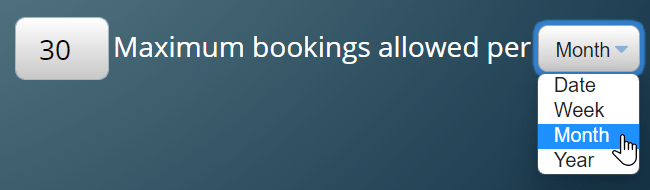
For MIDAS v4.30 we’ve improved the range of options available for the “Maximum bookings allowed” setting.

This is a per-user setting enabling administrators to restrict the number of bookings individual users can make for a given period.

This setting itself isn’t new – it was first introduced in v4.11. However, this setting initially only allowed an administrator to set a maximum number of bookings each user could add to any individual date.

For v4.15, the setting was expanded to include an alternative “Per Week” option. This allowed restrictions to be placed on the maximum number of bookings a user could add to any given week.

With MIDAS v4.30, we’ve now added a further two options to this setting – Month and Year.

These new additional options give administrators even greater control over bookings. Users can now be limited to a maximum number of bookings for any date, week, calendar month, or calendar year.


Maintain fixed spacing between bookings

Work on the next update to our popular web based room booking and resource scheduling, MIDAS, is nearing completion. We’re excited to reveal some of the exciting improvements you can look forward to first here on our blog…

Resulting from customer feedback (which we love getting by the way!), we’re introducing new global settings for v4.15 allowing administrators to enforce fixed spacing (or “gaps”) between adjacent bookings.

Maintain Spacing (Gaps) Between Bookings
Enforce a “gap” between adjacent bookings in MIDAS

This can be useful to allow for room setup, breakdown, reset or cleaning periods between adjacent bookings.

Two new settings are available in this regard. The first controls the amount of free time to maintain before each booking. The second, the amount of free time after each booking finished before the next one can commence.

For example, with the booking spacing settings shown in the screenshot about (15 minutes before / 30 minutes after), and a booking taking place between 2pm-3pm;

  • The latest allowed finish time of a booking added earlier in the day would be 1.45pm,
  • The earliest allowed start time of another booking added later on the same date would be 3.30pm.

You may like to check out some of the other features of MIDAS v4.15 too!