Category: News

MIDAS at 20: Celebrating Two Decades of Room Booking Innovation

MIDAS turns 20

March 2026 marks 20 years since the very first public release of MIDAS. We first unveiled Version 1.00 of our room booking and resource scheduling software to the world on 11th March 2006.

Where it all began

Work actually began on MIDAS a few months earlier. In December 2005, Mark Harrington, the creator of MIDAS, was working in a brand new Performing Arts College – the first of its kind in Greater Manchester, UK.

This new school for students aged 11-16 boasted impressive state-of-the-art facilities. These included sports facilities, dance studio, 300-seat community theatre, outdoor stage, recording studios and rehearsal space.

All these spaces were available for internal use during the school day and for hire by external clients and community groups in the evenings, weekends, and school holidays.

Soon after the new school opened, the school appointed a Community Facilities Manager, Miriam. Her role was to oversee bookings and the smooth operation of the exciting new facilities. Demand from the local community was immediately high.

It soon became obvious that the software the school had been using for handling their room bookings was not up to scratch. It was simply not meeting the increasing demands on the busy new facilities.

The (now defunct) software named “VenueBooker”, was slow, cumbersome, buggy, and not very user-friendly.

After much discussion, frustration, and plenty of “wouldn’t it be great if we had a system that could…?” conversations, they soon realized that no existing alternatives did everything they wanted from an ideal room scheduling system.

The Problem That Sparked an Idea

Mark had a strong programming background. He was confident he could build something that covered everything a Community Facilities Manager would need — facilities, clients, and bookings.

So Mark sat down with Miriam and the two of them brainstormed how she wanted the software to ideally function.

Dozens of sheets of paper later, covered with all kinds of scribbled notes, arrows, and flow charts, Mark had something to go away and work on!

A few days later, Mark had a working prototype: MIDAS v0.01.

Mark named the software “MIDAS”, although to this day he has never confirmed whether that’s an acronym that stands for “Mark’s Infrastructure Daily Allocation System“, or “Miriam’s Infrastructure Daily Allocation System“(!)

Over the Christmas holidays of 2005, Mark worked diligently to develop and improve MIDAS, ready to deploy it at the school in the new year.

He even spent New Year’s Eve sitting in front of his computer at the stroke of midnight, coding away!

Within the first few weeks of 2006, MIDAS went “live” at the school for the first time. It transformed the way staff and external clients booked rooms.

Now for the first time, staff could check room availability themselves using just their web browser. The booking process was simpler, more efficient, and streamlined. Bookings increased substantially, revenue rose accordingly, and double-bookings were finally a thing of the past.
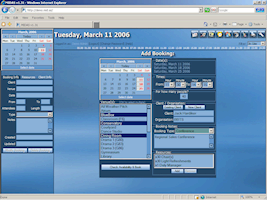
An early version of MIDAS in 2005

Going Public

Mark quickly realised MIDAS could help other schools and organisations facing the same challenges. Just a few months after the first internal prototype, he publicly released MIDAS v1.00 on 11th March 2006.

What began as a solution for one school has since grown into a trusted booking system that organisations across the world rely on.

Fast forward to 2026

For twenty years, MIDAS has evolved alongside changing technologies, shifting user expectations, and an increasingly competitive software landscape.

In that time, we’ve helped thousands of users in dozens of countries manage millions of bookings.

Our resource scheduling software remains in active development and we remain true to our original ethos of helping organizations of all shapes and sizes better manage their facilities and resource bookings.

Through browser revolutions, mobile adoption, cloud computing, and changing security standards, MIDAS has continuously adapted without losing its core mission.

New feature-rich updates are released at least three times a year, and many loyal customers stay with us for years.

Celebrating our 20th Anniversary

To coincide with our 20th anniversary, today we’re releasing the latest update to our MIDAS software, v4.42. Read about the new features in MIDAS v4.42.

Also to mark the 20th anniversary of our MIDAS room booking software, for a limited time – until 31st March 2026 – new customers get 20% off with Promo Code MIDAS20.

The Future

We’re tremendously proud to have been here for the past 20 years.

In that time, hundreds of competitors have appeared, many of whom were short-lived and have since vanished. MIDAS has stood the test of time.

To all our customers, whether you’ve been with us for the past 20 years, or just the past month – we appreciate you choosing MIDAS and sincerely thank you for your support! – You’ve committed to us, and we in turn continue to be fully committed to you.

New to MIDAS?

If you’ve never come across MIDAS before today (where have you been for the last twenty years?!) we appreciate that there’s a vast array of options out there today when it comes to choosing a room booking system.

Maybe you’re currently considering a change and are evaluating a number of different scheduling software solutions.

Whether you’re looking for a cloud booking or self-hosted booking system, a subscription or a perpetual license – we’ve got the facility management software for you!

When evaluating potential booking solutions, make sure you take into account 3 key factors:

  • How long a product has been established?
  • How frequently are updates released?
  • How responsive and reliable is customer support?

With MIDAS, you get a solid product from a trusted booking software provider with a proven track record. You get a stable system that’s in active development with unrivalled support to back it up!

Did you know that we even offer a no-obligation free 30-day trial today? Get yours today and experience the reliability that has defined MIDAS for two decades.

Twenty years ago, MIDAS began as a solution to a single school’s challenge. Today, it stands as a proven, stable, and continually evolving room booking solution trusted by organizations worldwide.

If you’re searching for a system built not just for today, but for the long term, now is the perfect time to experience MIDAS for yourself.

Don’t forget – use code MIDAS20 at checkout for 20% off your first purchase or subscription. Offer ends 31st March 2026.*

* Promotional Code valid until 31st March 2026 and is valid for initial MIDAS purchases or subscriptions only. We reserve the right to withdraw this offer at any time.

Why We’ve Switched from OpenAI to Claude

OpenAI vs Claude AI

Over the past week, a significant and fast-moving controversy has unfolded in the AI industry – one that has caused us, along with many others, to take a hard look at which AI companies we choose to support and partner with.

We’ve decided to switch. From today, MIDAS is moving away from OpenAI and over to Claude, the AI assistant developed by Anthropic.

Here’s why.

What Happened

If you haven’t been following the news, here’s a quick summary. The US Department of Defense had been using Anthropic’s Claude AI on its classified networks – the first AI to be deployed in that context. As the contract came up for renegotiation, the Pentagon demanded that Anthropic remove two key restrictions from the agreement: a prohibition on using Claude to power fully autonomous weapons systems, and a prohibition on using it for mass domestic surveillance of American citizens.

Anthropic refused. Their CEO, Dario Amodei, was unequivocal: current AI models are simply not reliable enough to be trusted with lethal autonomous targeting decisions, and mass surveillance of citizens is incompatible with democratic values. The company had tried for months to reach a workable agreement, but the Pentagon’s position was that it required the ability to use AI for “all lawful purposes” without restriction – a standard that, as legal experts have noted, is far broader than it sounds.

The fallout was swift. President Trump ordered every federal agency to immediately cease using Anthropic’s technology. Defense Secretary Pete Hegseth announced Anthropic would be designated a national security supply chain risk. Hours later, OpenAI – having apparently been in talks throughout – announced it had struck a deal with the Pentagon to fill the gap.

Many of OpenAI’s own employees were furious. A number of them, along with other prominent tech figures, signed an open letter opposing the government’s retaliation against Anthropic. Sam Altman himself had written in an internal memo just days earlier that OpenAI shared Anthropic’s “red lines” – before going on to sign a deal that critics said those red lines were far less robustly protected.

The contrast in the two companies’ behaviour was stark and, for us, clarifying.

Why This Matters to Us

We’re a small UK software company. We make room booking software. We’re not in the defence industry, and the intricacies of US military contracting aren’t something we’d normally have strong opinions about.

But this issue isn’t really about US military contracts. It’s about what kind of company you’re doing business with – what they stand for, and what they’re willing to sacrifice to stay in favour with those in power.

Anthropic chose to walk away from a government contract worth up to $200 million rather than remove safeguards they believed were ethically essential. OpenAI, in the same week its CEO had privately affirmed those same values to his own staff, made the opposite choice.

We think that matters. The companies whose technology we choose to use reflect, in a small way, on us. And we’d rather reflect the values of a company that held its ground.

What We’ve Changed

We used OpenAI’s models primarily in two places within our products and workflows:

Miriam, our virtual assistant. When no live support agents are available, visitors to our website can get help from Miriam, our AI-powered chatbot. Miriam was previously powered by OpenAI. She’s now powered by Claude.

Code optimisation. As we written about previously, we’ve been using AI assistance to help our human developers optimise MIDAS source code – identifying opportunities to make our software run faster and more efficiently. We’ve switched that workflow from ChatGPT to Claude as well.

In both cases, the transition has been smooth. Claude is a highly capable model, and we’re pleased with the results so far.

We’re Not Alone

Claude surged to number one on the Apple App Store in the days following the controversy. Thousands of individuals and organisations made the same decision we did – not because Anthropic asked them to, but because the situation made the choice feel important.

It’s worth noting that this isn’t simply about picking a “winner” in a commercial rivalry. We genuinely hope the situation with Anthropic and the US government is resolved fairly and without further retaliation. Anthropic has, by all accounts, been one of the most thoughtful voices in AI development when it comes to safety and responsible deployment. The idea of that voice being sidelined – or punished for speaking up – should concern anyone who cares about where this technology is heading.

A Note on AI in MIDAS

As we’ve said before, AI is not taking over the development of MIDAS. Our software is, and will remain, built and maintained by our human team. But AI tools have become a genuinely useful part of how we work – and it matters to us that we use them thoughtfully, including being selective about whose tools we use and why.

If you have any questions about these changes, or about how AI is used in our products, please don’t hesitate to get in touch.


MIDAS 2025 Year in Review: Product Updates, Features, and Improvements

2025 marked 20 years since work first began on the concept of our MIDAS booking system, with the very first version “0.01” coming into existence on 10th December 2005.

None of those very early 0.xx versions were ever made public and were instead used to test and refine the functionality of the software and to fix bugs.

The first “public” release, v1.00, came just a few months later in early 2006, which means that 2026 will mark MIDAS’ “official” 20th anniversary.

Our software certainly has longevity and a proven track record, and two decades later remains in active development. We regularly release booking software updates with new and improved features, and in this post we thought we’d summarize some of the highlights over the past 12 months.

💬 Unrivalled Customer Support

As well as the peace of mind our longevity gives to users, we know that customers also care about good customer service. This is just one of the areas that our customers regularly praise us for.

At the start of the year, we reviewed how responsive our support service had been over the previous 12 months, and you can read our customer support performance review.

♻️ Reduced Environmental Impact

Given our high levels of service, we clearly care about our customers. But we also care about the environment too.

As with any online or cloud-based business, computer and server equipment runs on electricity.

The Website Carbon Calculator is an innovative initiative which analyzes five key metrics to estimate the carbon emissions of any website.

Back in 2021 we were “greener” than 86% of all websites globally.

By 2025, we are now greener than 91% of all websites, and have reduced our carbon footprint by 5% over that period.

🇺🇸 US Tariffs

In April 2025, US President Donald Trump announced he would be imposing new ‘Tariffs’ on the majority of countries in the world, including the UK (where we’re based).

Concerned US customers were reaching out to ask whether the cost of MIDAS was affected by these tariffs. The good news was that tariffs only applied to physical or tangible goods – they didn’t apply to “services”, and therefore our prices for US customers were unaffected.

Politics aside, here’s what else happened in MIDAS in 2025…

⏱️ Staying “Signed In”

In April 2025, MIDAS v4.29 introduced a brand new “Stay signed in” option that truly allowed users to remain signed in between sessions. This was a game-changer for many who were frustrated at having to sign-in each time they opened their browser.

Of course remaining signed-in was something that could already be achieved with Single Sign-In (SSO) support via Active Directory – something MIDAS has supported for some time.

🔐 Improved Single Sign-On (SSO) support

In August 2025, for v4.40, we improved Single Sign-On support by expanding support to include SAML 2.0 Identity Providers.

🚪 Venues, Rooms, Spaces, and more

When we first came up with the concept of MIDAS two decades ago, we needed a term to refer to the “spaces” being booked. If you don’t know, MIDAS was originally written for a school environment, and we didn’t want to use “room” for facilities like sports halls or dance studios. We settled on the generic term “venue” to refer to a “bookable space” within the software, and this terminology has been in use ever since.

However, this year we introduced a brand new setting to replace the term ‘venue’ with something more applicable to what each organization uses MIDAS for. So if you’re a bowling alley, you can change the term to “lane”. Or if you’re running a complex of recording studios, you can change venue to “studio”.

🧾 Invoice Improvements

Invoicing is arguably the one area in MIDAS that receives the most user suggestions for new and improved features. That’s certainly not to say that the extensive invoicing capabilities of MIDAS aren’t good enough – it’s simply that every organization invoices differently – there’s no “standard that everyone uses”. That’s even more true as we have customers in dozens of countries around the world, and accounting/audit rules differ between jurisdictions.

Our most recent improvement to invoicing in 2025 was to support setting tax rates to three decimal places. Now, in most places in the world, tax rates are given to two decimal places, but there are actually a few exceptions!

Here are some examples:

  • Washington (United States):
    Washington law allows certain local sales/use tax rate increases in 0.001% increments
  • California (United States):
    California’s district sales taxes commonly use 0.125% increments. 
  • New York City (United States):
    8.875% is the combined sales tax rate in New York City. It comprises 4.00% (New York State sales tax), 4.50% (New York City sales tax), and 0.375% (Metropolitan Commuter Transportation District (MCTD) surcharge).

Allowing for tax rates to be specified to three decimal places, ensures MIDAS can accurately support regional and local tax rules across different jurisdictions.

This year, we also made invoices searchable and allowed the order of invoice items to be changed. Plus we provided greater control over unsent invoices by allowing an administrator to specify a date each month when unsent invoices are automatically sent to customers. This improvement better accommodates organizations that typically invoice on a specific date every month.

⬇️ Import Improvements

The ability to import data into a MIDAS resource scheduling system is crucial. Many customers who make the switch to MIDAS naturally wish to import data from their previous venue booking system.

The import tool in MIDAS allows for this. However, every booking software application is different – there’s no standardized format for how an application chooses to store and present data.

So our import tool strives to accommodate as many different data formats and “peculiarities” as possible for maximum compatibility when migrating from other booking systems.

In 2025, we introduced support for importing ‘dynamic’ .csv files. Traditionally, a Comma Separated Values (or CSV file) contains “one record per line”.

Some booking systems export to .csv files in a non-standard way, where data may actually be split across multiple lines. MIDAS can now support importing such files.

MIDAS also now supports importing multi-venue bookings. Traditionally, each record or “row” in a CSV file containing bookings should equate to a single booking (i.e. one row = one booking). However, some booking systems, such as Skedda, export multi-room bookings (where a booking takes place across multiple bookable spaces) as single records.

When importing such data into MIDAS, the software can now correctly identify and process such records.

📋 Logging and Audit Improvements

Every MIDAS booking system includes a “Recent Activity” log. In this audit log, every user action which takes place in the booking system is timestamped and logged. This allows administrators to keep track of all activity occurring within the system.

We’ve made a number of improvements in this area in 2025, including:

  • The Recent Activity log now differentiates between custom booking and client fields
  • The Recent Activity log now differentiates between removed obsolete and unsent invoices
  • Changing MIDAS core settings is now recorded to the Recent Activity Log
  • Dynamically duplicated or moved bookings are more clearly identified in the Recent Activity log

👩‍💼New User Permissions

Audit logging is certainly very useful – but we also provide administrators the ability to set an extensive range of permissions to individual user accounts. In 2025, we’ve added two additional new user permissions:

📲 User interface improvements

The user interface – or UI – of MIDAS has evolved considerably since 2005. This has been driven by advancements in new web technologies, browsers, and style trends. At the same time, we also know that functionality and familiarity are also key drivers for our users.

We’ve made a number of UI improvements to MIDAS this year, including;

♿️ Accessibility Improvements

Accessibility on web pages and web apps simply wasn’t a “thing” back in 2005 when MIDAS was born. Today, it’s not only important, it’s an essential consideration for many.

We first built in keyboard shortcuts to MIDAS well over a decade ago, and not long after introduced a special “high-contrast” visual theme too. Since then newer technologies and accessible web standards have emerged, and we continually strive to make MIDAS more accessible with every update.

This year, we’ve made a number of tweaks including better contrast for text on the booking availability grid display on public booking/request screens. We’ve also revamped the included help documentation for our most recent update, v4.41, to make it more accessible.

✅ Optimizations

Whilst many of the changes we introduce with each new version are visible, many take place behind the scenes.

We frequently review the code that makes up our software, and we’re always looking for ways to make it more efficient and run faster. A couple of years ago we experimented with using AI to assist with code optimization, and the results were impressive.

We continue to use AI to assist with this task this year to realize some small performance optimizations Rest assured, we certainly don’t let AI loose on the source code, and a human review of all AI generated code optimizations is carried out before the changes are accepted.

In addition to code optimization, we also look at database query optimization. These are the “commands” that MIDAS sends to the backend storage database, and the data it receives back in response. Communication with the database is actually one of the biggest factors that can affect performance, and so any gains in this area are always welcome.

We’ve made a number of optimizations to both code and database queries in 2025 to further improve performance and responsiveness of our software.

➕ New Add-ons

This year saw the introduction of two exciting new optional “add-ons” for MIDAS, allowing you to;

🔎 Looking ahead to 2026

As we mentioned at the top of this article, MIDAS officially celebrates its 20th anniversary in 2026, so watch this space for exciting updates in the coming months…


Will US-imposed tariffs affect MIDAS software prices?

On 2nd April 2025, US President Donald Trump announced that he would be imposing new ‘Tariffs’ on the majority of countries in the world.

Since then, a number of customers have reached out to us to ask us if this will have any impact on the price of MIDAS.

The short answer is no!

As you may be aware, we’re a UK-based business. Whilst President Trump is levying a 10% tariff on the UK, the newly announced tariff plans apply only to physical goods traded between countries.

The tariffs do not apply to services, which include sectors such as banking, finance and legal services.

Our booking system, MIDAS, is a software product. We do not supply physical or tangible goods – we supply a software service.

As such, the recently announced tariffs by the US do not apply to the supply of our software.

Consequently, the price of our software remains unchanged. In fact, we haven’t raised our prices now in over 5 years!

It remains to be seen what wider global impact the tariffs announced by President Trump will have on economies around the world.

However, as it stands today (which at time of writing is 3rd April 2025) – we have no plans to increase our pricing as a result of the tariffs announced in the US yesterday.