2 minute read time · Updated August 25, 2026 · First published August 25, 2026
Back in 2021, we launched our Refer-a-Friend program, giving existing MIDAS customers a simple way to earn free months on their subscription just by recommending us to other organizations.
Since then, it’s remained one of the easiest ways to save on MIDAS. For every new organization that purchases or subscribes to MIDAS using your unique referral link, you both get one month free, with no limit on how many times you can do it.
Today, we’re making the program a little more flexible. Previously, a referral needed to result in a purchase within 60 days of your link being clicked in order to track. We’ve now extended that window to 90 days.
Why 90 days is better
Choosing a room booking system usually isn’t a decision one person makes alone, and it’s rarely made on the spot. A longer tracking window gives the organizations you refer more time to:
Get budget signed off, particularly for schools, churches, and community groups working around fixed annual budgets or committee approval cycles.
Loop in the other decision-makers who need to weigh in, whether that’s a facilities manager, a finance lead, or a board
Try the free trial properly, rather than rushing a decision just to beat a tracking deadline.
Compare us against other options at their own pace, and still come back once they’re ready.
In short, more time means more of your genuine referrals actually get credited, rather than quietly missing out because a decision took longer than 60 days to reach.
If you haven’t grabbed your free referral link yet, you can get yours right here.
6 minute read time · Updated July 8, 2026 · First published July 8, 2026
Booking and scheduling should be quick. Yet checking whether a room is free, adding a booking, or pulling up next week’s schedule still usually means logging in, clicking through menus, and filling in forms. What if you could simply ask?
We are pleased to announce the new MIDAS MCP Server add-on, which lets you connect your MIDAS room and resource booking system directly to the AI assistant of your choice, including Claude, ChatGPT, and Google Gemini. Once connected, you can check availability, add and amend bookings, look up clients, manage resources, and even raise invoices, all through natural conversation.
What is an MCP server?
MCP stands for Model Context Protocol. It is an open standard that lets AI assistants connect securely to other software and data sources. On its own, an AI assistant has no way to look things up in your systems or carry out actions in them. An MCP server bridges that gap. It exposes a defined set of “tools” that an AI assistant is allowed to use, so the assistant can read information from a connected system and, where permitted, make changes to it too.
Because MCP is an open standard, any AI platform that supports it can connect to a compatible MCP server. That means the MIDAS MCP Server is not tied to a single AI provider. You choose the assistant you already use and prefer, and connect it to MIDAS.
Book and manage rooms using plain English
Once the MIDAS MCP Server is enabled and connected to your AI assistant, everyday booking tasks become as simple as asking a question. For example, you could say:
“Is the Boardroom free tomorrow afternoon?”
“Book Studio 1 from 2pm to 4pm on Friday for a client meeting.”
“Show me all bookings for Meeting Room 3 next week.”
“Which rooms are available on Thursday morning for 20 people?”
“Generate an invoice for last month’s confirmed bookings for Acme Ltd.”
Your AI assistant translates each request into the appropriate action, sends it to MIDAS, and replies in plain English. There are no menus to navigate and no forms to complete for these routine tasks.
A booking and scheduling system that works with your AI agent
If you have been searching for a booking, scheduling, or calendar system that integrates with your chosen AI agent or platform, the MIDAS MCP Server is designed for exactly that. It turns MIDAS into a fully AI-accessible booking system, without locking you into any one AI provider.
This opens the door to more than just chat. Because any MCP-compatible AI assistant or agent can connect, you can build assistants and automations around your booking data. Think of a front-of-house assistant that answers availability enquiries, or an agent that drafts invoices from the week’s confirmed bookings. If a platform supports MCP, it can work with MIDAS.
Availability
The MIDAS MCP Server is an optional add-on available from MIDAS v4.43 (or later). It’s available for both cloud-hosted an self-hosted editions of our booking system.
Existing customers (running MIDAS v4.43 or later) can add the MCP Server add-on to their system via mid.as/upgrade.
New customers can obtain MIDAS with the optional MCP Server add-on via mid.as/pricing.
Which AI platforms are supported?
The MIDAS MCP Server works with any AI assistant or platform that supports the Model Context Protocol, including:
Claude (Anthropic), via both Claude Desktop and the Claude web and mobile apps.
ChatGPT (OpenAI), via its Connectors feature.
Google Gemini, via the Gemini CLI.
Other MCP-compatible platforms, including a growing range of AI-powered tools and agent platforms.
Support for MCP is expanding quickly across the AI industry, so the list of compatible platforms continues to grow.
Built with security and control in mind
Giving an AI assistant access to your booking system is a significant step, so our MIDAS MCP Server puts you firmly in control:
Read-only mode – Start by allowing enquiries and availability checks only. The AI can look things up but cannot change anything. Enable write access later, when you are ready.
Secure by default – Connections require HTTPS and are protected by a confidential MCP key that you generate and can revoke at any time.
IP restrictions – Optionally limit access to specific IP addresses.
Your existing rules still apply – Every action taken through the MCP server respects the same permissions and business rules that already govern your MIDAS system. You can even configure the MCP to inherit the permissions of a specific user account.
A clear activity trail – Actions taken through the MCP server can be recorded in your MIDAS Recent Activity log, so you can see what was done.
Everything you can do
The MIDAS MCP Server provides a comprehensive set of tools covering the full range of day-to-day booking and administration tasks, including:
Checking venue and resource availability
Adding, amending, deleting, and restoring bookings
Approving and rejecting pending booking requests
Looking up and managing clients
Managing venues, venue groups, and bookable resources
Checking consumable stock levels
Raising, amending, and generating invoices
Sending notifications and emailing clients
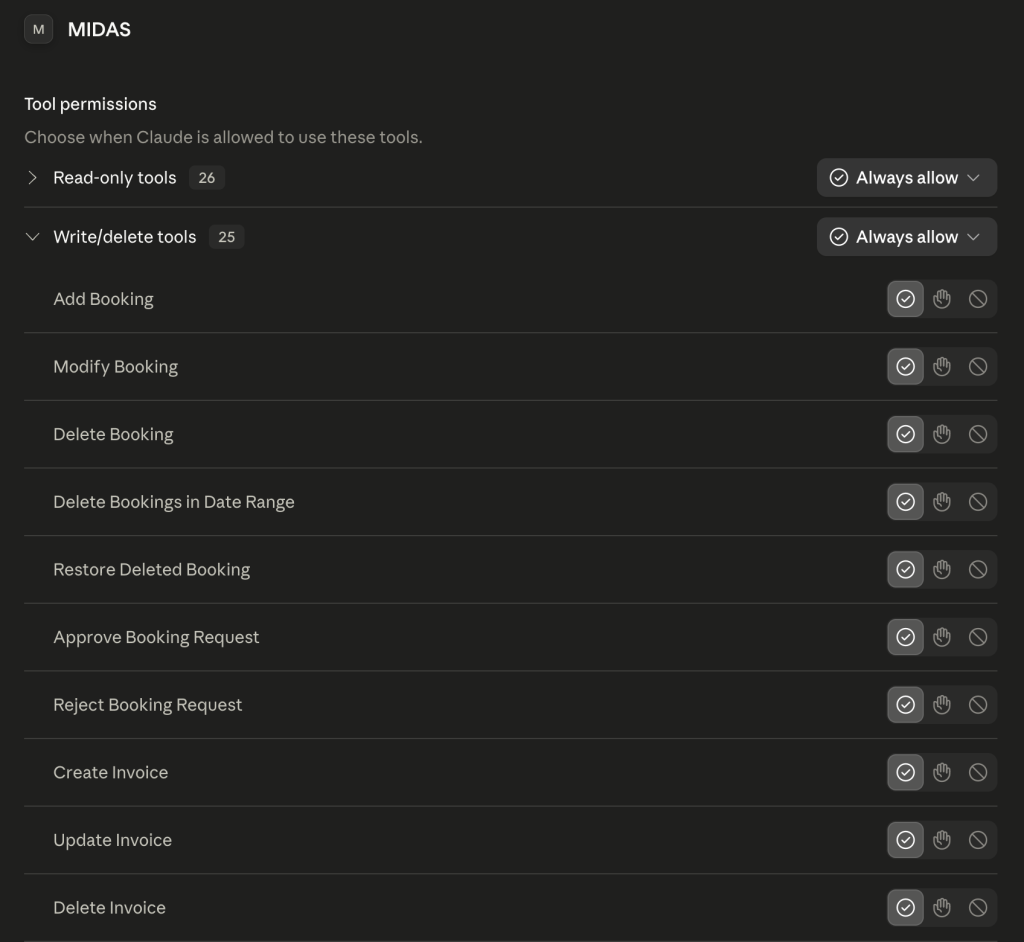
Some of the tools available in the MIDAS MCP Server (shown here in Claude Desktop)
Read-only tools retrieve information only, while write tools can create and change data. If you run the server in read-only mode, only the read-only tools will be available.
Getting started
Setting up the MIDAS MCP Server takes just a few minutes:
AI assistants are quickly becoming part of everyday working life. With the MIDAS MCP Server, your booking and scheduling system is ready to be part of that shift. Whether you want to check availability at a glance, speed up routine admin, or build richer automations around your booking data, the MIDAS MCP Server connects MIDAS to the AI tools you already use.
4 minute read time · Updated July 8, 2026 · First published July 7, 2026
Managing bookings usually means clicking through calendars, forms, and menus. What if you could just say what you wanted instead?
MIDAS v4.43 introduces Voice Control – a hands-free way to navigate your booking system, manage reservations, and take care of everyday admin tasks, just by speaking naturally.
How it works
Click the microphone icon, say what you want, and MIDAS takes care of the rest. No rigid command syntax to memorise, no button hunting – just plain English.
Want to check what’s on today? Just say:
“What’s on today?”
Need to book the Guest Room for 11am tomorrow?
“Book the guest room tomorrow from 11am to 2pm”
Looking for an invoice?
“Show me invoice MIDAS0155”
That’s it. MIDAS listens, understands, and acts.
What you can do with your voice
Voice Control covers the tasks you reach for most:
Navigate your calendar – jump to any date, step forward or back by days, weeks or months, or say “show next Friday’s bookings”
Add bookings – specify a venue, date, time, and client all in one sentence
Modify, move, or copy bookings – reschedule a booking to a new time, duplicate it to another room, or move it to next week
Delete bookings – cancel with a single spoken command, with a confirmation step to prevent mistakes
Manage reminders and availability watches – add a reminder or a watch for any booking without leaving the calendar view
Generate and view invoices – create an invoice for a booking, or jump straight to an existing one by reference number
Search – find bookings, clients, or invoices matching a keyword
Check notifications – ask for your messages, reminders, or availability watches
Jump to admin settings – open any settings page by name, from user management to security options
Sign out, view statistics, check recent activity – and more
MIDAS is also flexible about how you phrase things. Say “cancel,” “delete,” or “remove” – they all work. Ask for a booking “in the guest room at 2pm” or “at 2pm in the guest room” – either order is understood. You can even say “please” or “could you” if that’s how you naturally talk; MIDAS will politely ignore the pleasantries and get straight to the task.
Voice Control supports two modes to suit how you like to work:
Momentary mode – press and speak a single command, then release. Ideal for quick, one-off actions.
Toggle (“Hey MIDAS”) mode – activate listening once and issue a stream of commands hands-free, prefixing each with “Hey MIDAS.” Great for busy front-desk environments where reaching for a mouse isn’t always convenient.
When MIDAS asks for confirmation – for example, before deleting a booking – you can simply respond “yes” or “cancel” without needing to repeat the wake phrase.
Built with the same permissions you already trust
Voice Control respects your existing MIDAS permission structure. If a user doesn’t have permission to delete bookings, manage users, or view invoices, voice commands for those actions are blocked in exactly the same way the standard interface already protects them. Nothing new to configure – it simply works within the access rules you’ve already set up.
Give it a try
Voice Control is available from MIDAS v4.43 (and later) for all users with the appropriate permissions.
Just look for the microphone icon in your MIDAS toolbar, click it, and start talking.
Whether you’re juggling a packed calendar or just want a faster way to get things done, Voice Control is designed to get out of your way – so you can focus on the booking, not the interface.
5 minute read time · Updated April 8, 2026 · First published March 25, 2026
If your MIDAS booking system is currently configured to send emails via Microsoft’s SMTP servers, it’s time to take action.
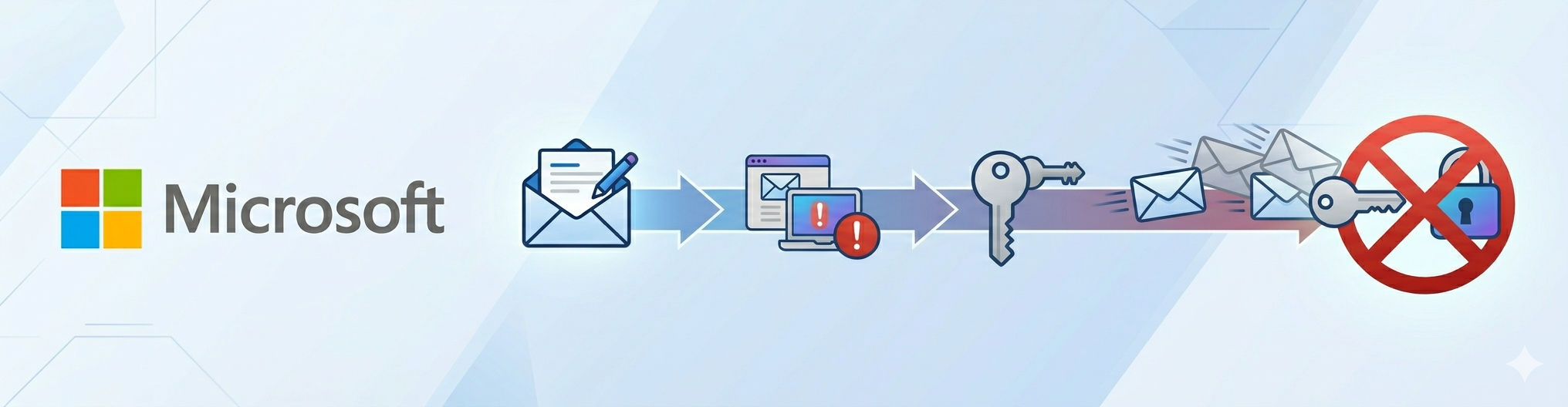
Microsoft has announced that it will be retiring support for SMTP AUTH (also known as “Basic Authentication” for SMTP) in 2026. Once this change takes effect, any application which is configured to use Microsoft SMTP endpoints for outgoing mail will no longer be able to send emails.
For MIDAS, if you’re using Microsoft’s SMTP servers, this means that booking confirmations, reminder emails, and other automated notifications sent from MIDAS would silently fail – potentially disrupting your organization’s scheduling and communications.
Here’s what you need to know, and what steps to take before the deadline.
What Is SMTP AUTH and Basic Authentication?
SMTP AUTH is a method that allows applications to authenticate with a mail server using a username and password in order to send outgoing email. It has been widely used for decades.
Why is Microsoft removing Basic Authentication and SMTP AUTH?
It’s worth noting that Microsoft’s decision to retire SMTP AUTH is driven by their own platform strategy around modern authentication – it doesn’t mean that sending email via SMTP is inherently insecure. Under the hood, SMTP works the same way it always has, and the username/password authentication used by SMTP hasn’t fundamentally changed. What Microsoft is retiring is the ability to authenticate to their mail servers this way, as they push users towards OAuth-based access within their ecosystem. MIDAS does not currently support OAuth, but this is not a concern — there are plenty of reliable, independent SMTP providers that continue to support standard SMTP authentication without any issues.
Are You Affected?
You may be affected if your MIDAS booking system’s outgoing email settings are currently configured to use any of the following SMTP servers:
smtp-mail.outlook.com — used by personal Outlook.com/Hotmail accounts
smtp.live.com — an older endpoint also associated with Outlook.com/Hotmail/Live accounts
smtp-legacy.office365.com — a temporary fallback endpoint for Microsoft customers that stilled relied on SMTP AUTH after the initial Basic Auth deprecation push.
smtp.office365.com — An Exchange Online endpoint used by Microsoft 365 services.
outlook.office365.com — another Exchange Online endpoint sometimes used in place of smtp.office365.com
You can check your current email sending settings via MIDAS Admin Options > Email.
The good news is that the fix is straightforward, and we’ve made it as easy as possible for MIDAS customers.
For Cloud-Hosted MIDAS Customers
If you’re on our cloud-hosted platform, we have the simplest possible solution for you: switch to MIDAS’s built-in Zero-Configuration Email Delivery.
This option requires no SMTP credentials, no third-party accounts, and no technical configuration on your part. MIDAS handles email delivery on your behalf, so you don’t need to worry about SMTP servers at all. You can find full details on how to enable this feature in our dedicated guide:
We strongly recommend all cloud-hosted customers make this switch at their earliest convenience – and certainly before Microsoft’s 2026 deadline.
For Self-Hosted MIDAS Customers
If you run MIDAS on your own server or hosting environment, you’ll need to update your outgoing mail settings to use an alternative SMTP provider. Fortunately, there are several excellent options available, many of which offer generous free tiers that would suit most MIDAS installations.
We recommend the following providers:
SMTP2GO
SMTP2GO is a reliable, cloud-based email delivery service with a free tier that allows up to 1,000 emails per month. It’s straightforward to set up and works seamlessly with MIDAS’s outgoing mail settings. Simply create a free account, verify your sending domain, and update your MIDAS SMTP settings with the credentials provided.
Mailgun
Mailgun is another popular transactional email service offering a free tier for low-volume sending. It provides robust deliverability, detailed sending logs, and is well-suited for automated system emails like those generated by MIDAS. After signing up and verifying your domain, update your MIDAS SMTP configuration with your Mailgun credentials.
To update your SMTP settings in MIDAS, navigate to MIDAS Admin Options > Email and enter the new SMTP server details provided by your chosen transactional email delivery service.
Now to December 2026: SMTP AUTH Basic Authentication behavior remains unchanged.
End of December 2026: SMTP AUTH Basic Authentication will be disabled by default for existing tenants. Administrators will still be able to enable it if needed.
New tenants created after December 2026: SMTP AUTH Basic Authentication will be unavailable by default. OAuth will be the supported authentication method.
Second half of 2027: Microsoft will announce the final removal date for SMTP AUTH Basic Authentication.
While Microsoft’s deadline is the end of December 2026, we recommend customers make this change sooner rather than later.
Email is a critical part of how MIDAS keeps your staff and visitors informed – from booking confirmations to reminders and notifications. A disruption to outgoing mail can go unnoticed until someone realizes they never received a confirmation, which can cause real-world scheduling problems.
Taking a few minutes now to update your settings will ensure uninterrupted email delivery well into the future. If you have any questions or need assistance, please don’t hesitate to contact our support team – we’re happy to help.