Category: News

Whatever happened to Google Checkout?

Google Checkout LogoOur MIDAS room scheduling software allows your customers to pay invoices for the hire of your rooms, facilities, and resources online.

This feature was first introduced back in 2010 with MIDAS v3.10. Since then, we’ve natively supported payment of invoices using either PayPal or Google Checkout.

Unfortunately, as of MIDAS v4.07 we have now removed – the now defunct – Google Checkout support from our software.

What was Google Checkout?

Google Checkout first came into being in 2006 with the aim of simplifying the process of paying for online purchases. Users would store their credit or debit card and shipping information in their Google Account. This allowed them to make purchases without having to re-enter their information each time, and secure in the knowledge that their card details wouldn’t be made available to the seller.

Transaction fees for using Google Checkout were initially free. However, as one of PayPal‘s main competitors, over time the transaction fees for using Google Checkout became identical to PayPal’s fees. Many of the each platform’s features also aligned, such as providing fraud protection and the ability for customers to track purchases.

Whilst PayPal and Google Checkout were in direct competition offering quite similar services, there were a number of differences.

On the plus side, once a merchant received a payment via Google Checkout it would be automatically withdrawn to the merchants bank account. PayPal, on the other hand, required merchants to manually withdraw funds to their bank account. On the downside, whilst PayPal supported transactions in multiple currencies; Google Checkout only accepted payments in the currency that the merchant’s bank account was in. It was not possible for Google Checkout merchants to accept multiple currencies.

Google Checkout Becomes Google Wallet

Google Wallet Logo In 2011, Google then announced a “rebrand” of Google Checkout to “Google Wallet”, but the services offered remained the same.

However, in late November 2013, Google Checkout was discontinued and the nature of “Google Wallet” shifted.

The shift in Google Wallet’s functionality

Google Wallet then become a method for making and accepting payments exclusively for apps and in-app purchases via the Google Play Store. It could no longer be used as an online payment processor for anything else.

Due to this new direction in which Google took their Google Wallet service in late 2013, the previous functionality we were able to offer in MIDAS – the ability for clients to pay their invoices online using Google Checkout/Wallet – no longer works. We therefore removed all Google Checkout/Wallet integration as of MIDAS v4.07.

We hope Google reconsider their stance to provide online payment processing solely for their own Google App Store. The more choice there is for both consumers and merchants alike the better. That said, there are numerous other online payment processors that have sprung up in recent times. These include notable solutions such as Amazon Payments and Stripe. Incidentally, Stripe is now our preferred card payment processor for purchases made through our website.

Going forward, we continue to support PayPal as a method to allow your clients to directly pay their invoices online for use of your rooms/facilities. In fact, we’ve also improved this support for v4.07 too! If you allow clients to pay invoices online via PayPal, PayPal can now automatically update the status of their MIDAS invoices once payment has been made. This means that you’ll no longer have to manually update invoices yourself! For more information, please see: Configuring PayPal Integration

We’re also keen to hear from you! Are any other online payment processors you’d like us to consider supporting in future updates to MIDAS? We can’t promise we’ll natively support them, but we’d love to hear from you!
Making card payments simpler

Following feedback from our customers, we are pleased to announce we are trialing a new card payment processor on our website. This will benefit those purchasing, renewing, or upgrading a MIDAS room booking & resource scheduling software using a Credit/Debit card. It will allow these customers to complete their purchase without having to go through PayPal.

PayPal Payments

Whilst PayPal is arguably the largest and most popular card payment processor on the Internet, one of the concerns some of our customers have is that in order to complete a card payment via PayPal they are forced to sign up for a PayPal account. Many do not want to do this.

PayPal advertises that customers can make card payments without also requiring a PayPal account. In some cases this is certainly true. However, it’s not true in all cases!

For example, after you’ve used PayPal for a number of “one off” card payments without a PayPal account, PayPal then insist you create an account to continue making card payments through their system:

“You will only be able to use PayPal … for up to [10] transactions before we will require you to open a PayPal account … to enable further use of the PayPal system. At that point you will be required to enter into our standard user agreement to govern the ongoing relationship with PayPal”

Additionally, the country you’re in can also affect whether PayPal will allow you to make a card payment without a PayPal account, or insist you create one first.

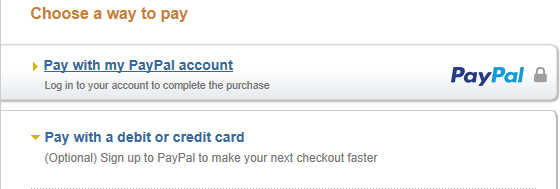
On a PayPal payment page, if your country is set to United Kingdom, you might see:

PayPal card payment without requiring a PayPal account

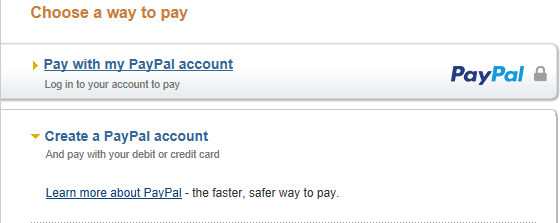
…Whereas change your location to Canada, and you’ll see:

PayPal card payment requiring a PayPal account first

…spot the difference?! Yes, the option to pay directly by card directly has been replaced with an option to create a PayPal account!

We want to make things simpler for all our customers who just want to pay by Credit/Debit card without signing up for any 3rd party accounts!

Introducing Stripe

Stripe.comSo whilst PayPal remains a payment method option for our customers, we’ve now also integrated Stripe into our secure site.

Stripe securely handles card payments directly from our website. So unlike PayPal, you’re not transferred back and forth between a hosted payment page on another site and then back to our site. You can complete your card purchase securely and directly from our website. Plus, you won’t need to sign up for a Stripe account to make your payment either!

We will be trialing Stripe for a number of weeks, and we’d appreciate your feedback!

We’ve also updated our site’s Privacy Policy accordingly.


Our unrivalled customer support improves yet again!

Customer Service

We constantly strive to provide unrivalled support to customers of our Web Based Room Booking & Resource Scheduling system. One of the things we’re most proud of is our professional, friendly, knowledgeable, and responsive customer support.

That’s why we regularly review how we’re performing on this front. We also make our findings public too. This helps ensure that customers who’ve taken out an Annual Support Subscription with their purchase of our scheduling software, are getting an unmatched support service!

To maintain our very high standards of service, we analyze the wait times between when a priority support email is received by us, and when a subsequent response is sent. And all these are responses by real people! They’re not some machine or AI generated auto-responder, but instead tailored responses from human!

We’ve now analyzed our performance again – this time for the month of June 2014 and the responsiveness of our support just keeps on getting better! When we first started analyzing our support response times, back in September 2012, we measured support response times in hours. Last September 2013, we felt the need to improve our measurements down to minutes!

How we’ve historically performed

The table below shows the percentage of Priority Support emails and how quickly they were answered between September 2012 and June 2014.

 September 2012January 2013September 2013June 2014
Answered within 15 minutes58.97%71.43%
Answered within 30 minutes74.36%77.14%
Answered within 1 hour76.29%85.95%87.18%91.43%
Answered within 2 hours90.72%91.23%94.87%97.14%
Answered within 3 hours92.78%94.74%94.87%100%
Answered within 4 hours93.81%96.49%97.44%100%
Answered within 5 hours94.85%98.25%100%100%
Answered within 6 hours96.91%98.25%100%100%
Answered within 7 hours98.97%98.25%100%100%
Answered within 8 hours98.97%100%100%100%
Answered within 9 hours98.97%100%100%100%
Answered within 10 hours98.97%100%100%100%
Answered within 11 hours100%100%100%100%
Our speed of response to Priority Support Emails

As you can see, between September 2013 and June 2014 we’ve improved again!! During June, ALL Priority Support emails were responded to within 3 hours of receipt. This was regardless of the day of the week, and that’s not an average – that’s…

Every single Priority Support email received in June was given a real, individually tailored, human response within 3 hours (and over 90% of those within just 1 hour)!

Now, how many companies do you know where you can get a real human response to your email that fast, any day of the week!!?

So if you’re considering MIDAS for your organization’s scheduling needs, but are perhaps worried about how good our support is or whether an Annual Support Subscription to MIDAS is worth having, well… the above figures speak for themselves!

…but if you’re still not convinced? Read some of our Customer Testimonials about our scheduling system and the outstanding level support we consistently provide!


Could Internet Explorer become open source?

Microsoft Internet Explorer 12
Today the Internet Explorer Developer Relations Team at Microsoft have hinted at the possibility that the browser may one day become “Open Source”.

“Open Source” is a term referring to software that whose source code is available for modification or enhancement by anyone. All other major web browsers (Mozilla Firefox, Google Chrome, Opera and Safari are based on open-source components). Presently, Internet Explorer is the only one of the big 5 browsers to remain entirely “closed source”.

As part of their #AskIE event on Twitter today, questions were invited on the current status and development of Internet Explorer. One question in particular was posed as to whether Internet Explorer would “ever consider going open source to speed up develop/bug fixing?“. The response to this question from the people behind the browser was “We consider many things!

Why is this significant?

Well, Microsoft have come under much criticism in the past over how slowly they release major updates to their browser. Five years passed, for example, between the releases of IE6 and IE7, and then another 3 before IE8! (Compare that with say Mozilla, who’ve been releasing major updates to Firefox every six weeks for some time now!). Whilst there were of course critical “security updates” and patches to IE in those big gaps between major releases, no “new features” or support for new web standards were introduced. This meant a headache for developers of websites and web based apps.

Developers had to ensure “backwards compatibility” with “stagnant” versions of IE. At the same time, developers wished they could take advantage of newer web standards and technologies which all the other major browsers supported, yet IE didn’t.

In the development of our browser based room booking system, MIDAS, we’ve had to take difficult decisions in the past. We’ve previously decided to drop support for IE6, IE7 and then most recently IE8. This was despite these browsers still having notable market share at the time we took those decisions.

To add to that, whenever Microsoft have released a “major” update to Internet Explorer, it’s not always available for all Windows Operating Systems. Windows XP users for example can’t run anything higher than IE8. Actually, if you’re still using Windows XP… well, you really shouldn’t be!!

Would Internet Explorer becoming “open source” help?

Well, first of all, more developers would be able to get involved in the project by adding support for new and emerging technologies and standards. Secondly, it would also mean that bugs could be more readily identified and fixed. These two factors alone would undoubtedly lead to a faster release cycle, and greater compatibility with the latest standards!

In terms of support for the latest web standards, Internet Explorer is way behind. IE11 (the current version of IE generally available) is only 67% compatible with the latest web standards. This compares to Opera 22 and Firefox 30, both on 85%, with Google Chrome 35 edging ahead with 86% compatibility (Source: caniuse.com)

We’d love to see a faster release cycle for Internet Explorer and the same support for technologies and standards in IE that other browsers have had for some time!

Internet Explorer Developer ChannelOn a positive note, earlier this week, a new “developer preview” of Internet Explorer emerged. This was made available through the new “Internet Explorer Developer Channel“. This preview is designed to give developers like us a first look at what to expect in IE12. The big question now is how long will it be until IE12 actually becomes available to end users? Will Microsoft wait until Windows 9 is released (Like they did with IE10 and Windows 8), or will we see the next major update to Internet Explorer sooner?

Let’s hope so!

You might also be interested in:
Mozilla: The browser vendor who USED to believe in equality and freedom of speech!
The Best Web Browser? Internet Explorer 11, Chrome 31, Firefox 25, Opera 17, or Safari 5?