Posts Tagged: email

Improve email delivery: The importance of SPF

In this blog post, we’ll take a look at SPF and why its important in ensuring email from your MIDAS room booking system is reliably delivered.

SPF stands for “Sender Policy Framework” and its purpose is to prevent unauthorized people from forging your e-mail address and pretending to be you. SPF has been around for a number of years now, but in recent times has been growing in popularity as more and more websites and email providers start enforcing it.

As our MIDAS web based room booking systems are capable of sending email on your behalf, it’s important to understand how SPF works and how it can help solve email delivery issues in MIDAS.

Take for instance the following example Scenario:

  • Your MIDAS system is running on domain “A” (i.e. your-organization.mid.as)
  • Your MIDAS system is configured to send emails to appear as though they are sent from an email address belonging to domain “B” (i.e. your-organization.com)
  • An email is sent from your MIDAS system to a recipient with an email address on domain C

In the above example, the receiving mail server for domain C queries the SPF record on domain B to check whether domain A is authorized to send mail on behalf of domain B. If it isn’t the email is rejected.

An SPF record is simply a TXT record in a given domain’s DNS, and a simple example may look similar to this:

v=spf1 +a +mx ~all

The format of an SPF record begins with a version number; the current SPF version is “v = spf1”.
Following the version string, any number of expressions may be included which are evaluated in the order they appear. These consist of an optional “qualifier” (+, -, ~, or ?) and a “mechanism” (all, a, mx, ip4, or include). The first mechanism that is matched in the SPF record determines the result of the entire valuation of the SPF record.

Qualifiers:

QualifierResultDescription
+PassDefines an authorized sender
(If no qualifier is specified, + is assumed)
FailDefines an unauthorized sender
~SoftFailDefines an unauthorized sender
(however it may not notify the sender that their email failed)
?NeutralDefines a sender whose legitimacy isn’t determined
(In such instances, sending is allowed)

Mechanisms:

MechanismApplies if…
allalways
aAn A (or AAAA) record of the polled (or explicitly specified) domain contains the IP address of the sender
mxAn A (or AAAA) record of the polled (or explicitly specified) domain contains the IP address of the sender
ip4The specified IPv4 address is the IP address of the sender or of the specified IPv4 subnet which contains it
includeAn additional SPF request for the domain specified in the include statement contains the IP address of the sender

SPF records cannot be over 255 characters in length and cannot include more than ten “include” statements.

Example SPF record:

v=spf1 +a +ip4:1.2.3.4 -ip4:5.6.7.8 +include:somedomain.com ~all

In the above example:

  1. Email delivery will be allowed if it originated from the same domain it was sent (+a).
  2. Email delivery will also be allowed if it originated from the specific IP address 1.2.3.4
  3. Email delivery will be rejected if it originated from the IP address 5.6.7.8.
  4. Email delivery will be allowed if it matches the rules defined in the SPF record on “somedomain.com”
  5. All other email sources will be softly rejected (~all)

Bringing it back to MIDAS…

If you run a cloud-hosted MIDAS system at the domain “your-organization.mid.as”, your organization’s own website is “your-organization.com”, and you wish to allow your MIDAS system to send email on behalf of addresses @your-organization.com, then you should setup/modify an SPF record on your-organization.com.

This SPF record would authorize your hosted MIDAS system to send email on behalf of your organization. Failing to correctly set an SPF record for your domain may mean that emails sent from your MIDAS system may not reach recipients.

For our hosted customers, you can simply include “include:_spf.midas.network” in your-organization.com’s SPF record. Your new/modified SPF record may then look similar to this:

v=spf1 +a +mx include:_spf.midas.network ~all

In the above example:

  1. Email delivery will be allowed if it originated from the same domain it was sent (+a).
  2. Email delivery will be allowed if it originated from the same mail server as it was sent (+mx)
  3. Email delivery will be allowed if it matches the rules defined in the SPF record on “_spf.midas.network”. This will allow your hosted MIDAS system to become an authorized sender of email for your domain.
  4. All other email sources will be softly rejected (~all)

Remember, SPF records are simply TXT records within your domain’s DNS. If you’re not sure how to set/modify DNS records for your own domain, you’ll need to defer to the domain’s administrator, registrar, or hosting provider who should be able to assist in making the necessary adjustments to your domain’s DNS record

Further reading from our Knowledgebase:.

Additional Recipients for Booking Confirmations

When adding new bookings to MIDAS (or modifying existing ones) if there’s an email address on record for the client that you’re making/modifying bookings for, then MIDAS will offer a “Send Booking Confirmation?” tick box on the Booking Availability screen. Selecting this option will send an automated booking confirmation notification by email to the client when the bookings are made.

Sometimes, you may wish these booking confirmation notifications to go to multiple recipients in addition to the primary client that the bookings are for.

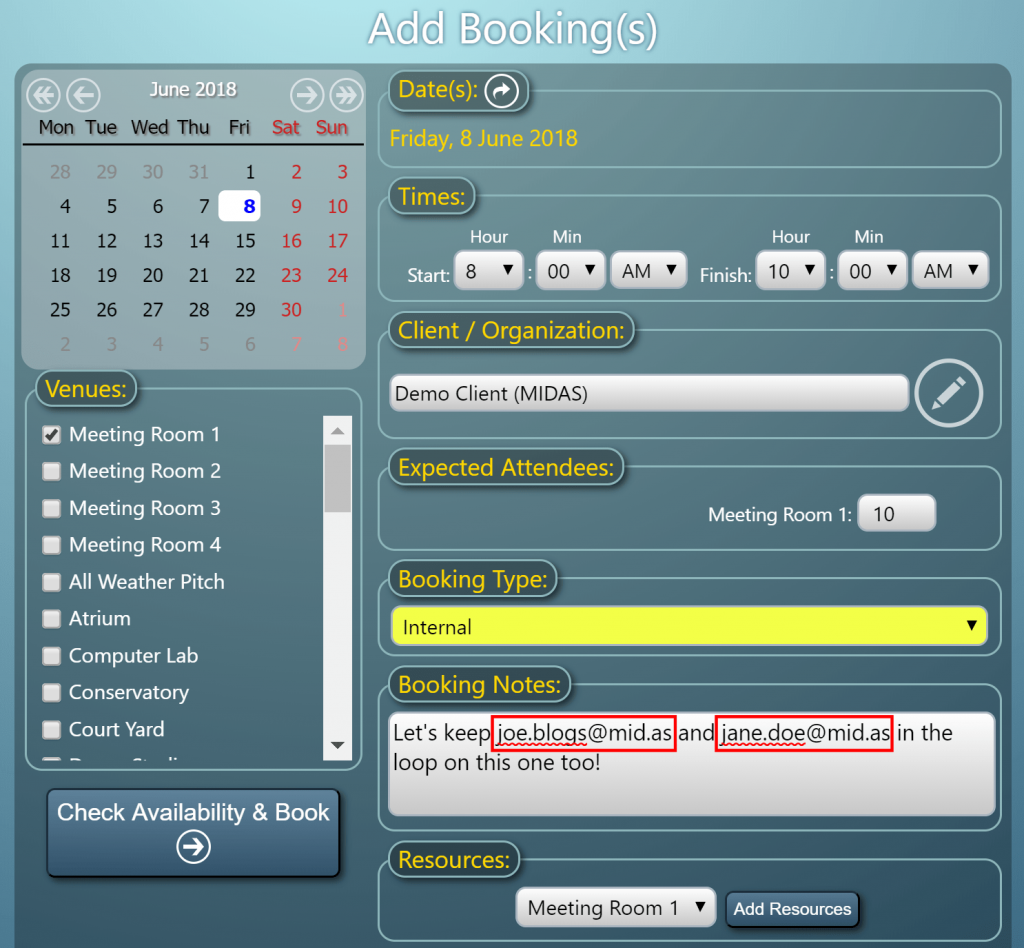
That’s why MIDAS (v4.19 and later) automatically detects any email addresses added to the standard “Booking Notes” field, or any text custom booking fields, and offer these as additional “CC” email addresses for the booking confirmation notification to also be copied to.

Here’s an example to illustrate:

Detect email addresses entered into booking fields

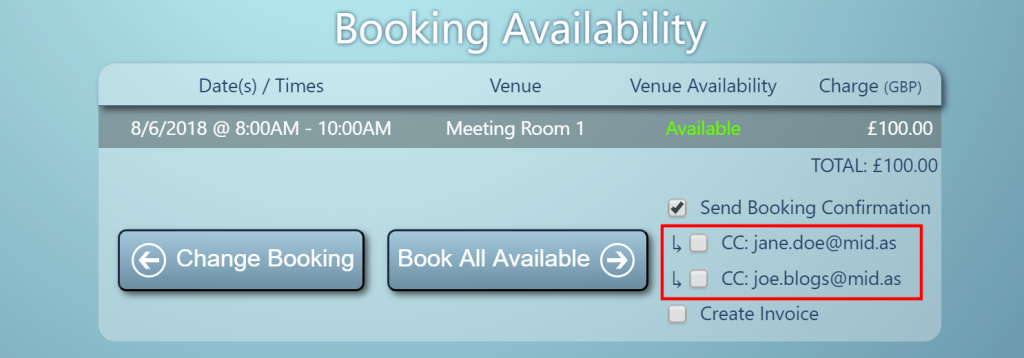
Two email addresses have been added to the “Booking Notes” field for the above booking. When “Check Availability and Book” is clicked, the following “Booking Availability” screen is shown:

Offer additional recipients for booking confirmation notification

Notice how MIDAS has detected these email addresses and offered each as an optional “cc” recipient for the booking confirmation email to the client.

Please Note: Cloud-hosted editions of MIDAS will detect a maximum of 5 additional email addresses in booking fields when MIDAS is configured to send via an external SMTP server, or a maximum of 2 additional email addresses when configured to send via the Sendmail option. There are no limits imposed in self-hosted editions.

MIDAS can be configured to send outgoing email via SMTP/Sendmail via MIDAS Admin Options → Manage MIDAS → Email. For more information, please refer to the “Manage Email Settings” documentation.

This isn’t the only new feature to be added in v4.19. There are a number of other new & improved features in MIDAS v4.19 too!


Greater Control Over BCC’d Email

The first big update of 2018 for our MIDAS web based room booking and resource scheduling system is nearly ready, and includes a number of user-requested features and improvements.

Now, MIDAS has included a “BCC outgoing email to” setting for quite some time now. This setting allows you to enter an e-mail address to which e-mail (excluding generated notifications) sent by your users through MIDAS will be BCC’d (Blind Carbon Copied) to.

It’s a useful setting, as it allows administrators to keep track of outgoing e-mails, or for archiving purposes.

However, the setting has caused confusion for some customers who instead expected this setting to send a copy of EVERY single outgoing email (including system-generated notifications) to the defined email address, rather than its intended use of only BCC’ing emails that are not generated notifications (for example, if a user emails a client through the in-built email function).

Therefore, to add greater flexibility for those customers who have requested it, we’ve expanded the email BCC capabilities of MIDAS for v4.18.

Choosing which emails to BCC

You’ll now be able to select which “types” of outgoing emails from your MIDAS system you’d like to be BCC’d to a pre-defined address:

Choose which types of email to BCC

The types of outgoing email you can choose to be BCC’d include:

  • Generic
  • Bookings:
    • Booking Cancellation
    • Booking Confirmation
    • Booking Reminder
  • Booking Requests:
    • Booking Request Approved
    • Booking Request Approved (with changes)
    • Booking Request Rejected
    • Booking Request Submitted
  • Invoices:
    • Invoice (Cancellation)
    • Invoice (Regular)
    • Invoice Overdue
    • Invoice Reminder
    • Receipt

We do however suggest that you think very carefully as to which types of emails you select to be BCC’d. For larger MIDAS systems this could result in a significantly higher volume of outgoing email traffic.

For this reason, the extended BCC email options for our “cloud-hosted” customers are limited to only be available if your MIDAS system is configured to send outgoing email via an external SMTP server/relay. If your cloud-hosted MIDAS system is configured to send email via the internal “Sendmail” option, extended BCC email options will be unavailable to you. This restriction does not apply to self-hosted MIDAS systems.

Click here to continue reading about some of the other new & improved features coming in MIDAS v4.18!


Reduce Email Notifications Whilst Logged-In

Development is nearing completion on the next update to our room booking and resource scheduling software, MIDAS. So we’re shedding a little light here on our blog on some of the new and improved features coming to v4.13…

When a new booking request or message is received, or a new “watch notification” triggered, MIDAS alerts the user. In the user is logged in, the relevant toolbar icon changes to denote the number of new booking requests or messages requiring their attention. Users can also optionally choose to see a list of these requests/messages each time they login in.

Furthermore, a user can optionally choose to be sent email notifications upon each new booking request, message, or watch notification.

With the upcoming new addition of Desktop Notifications in v4.13, which enables more prominent on-screen alerts to logged in users, we’ve added a useful new option to v4.13.

Suppress New Booking Request Email NotificationsSuppress New Message/Watch Notification Emails
Suppress new Booking Request email notifications whilst logged inSuppress new Message/Watch notification emails whilst logged in

The new settings will allow a user to suppress receiving such notifications in their email inbox whilst they are currently logged in to MIDAS. Email notifications will then only be sent during those times they’re away from their device, and logged out.

We believe these new per-user setting will help to reduce the number of redundant email notifications from your MIDAS system. But of course this setting can easily be toggled on/off by users at any time. If you do still want to receive an email notification on every new request/message – even when you’re logged in – you’ll still be able to do so!